


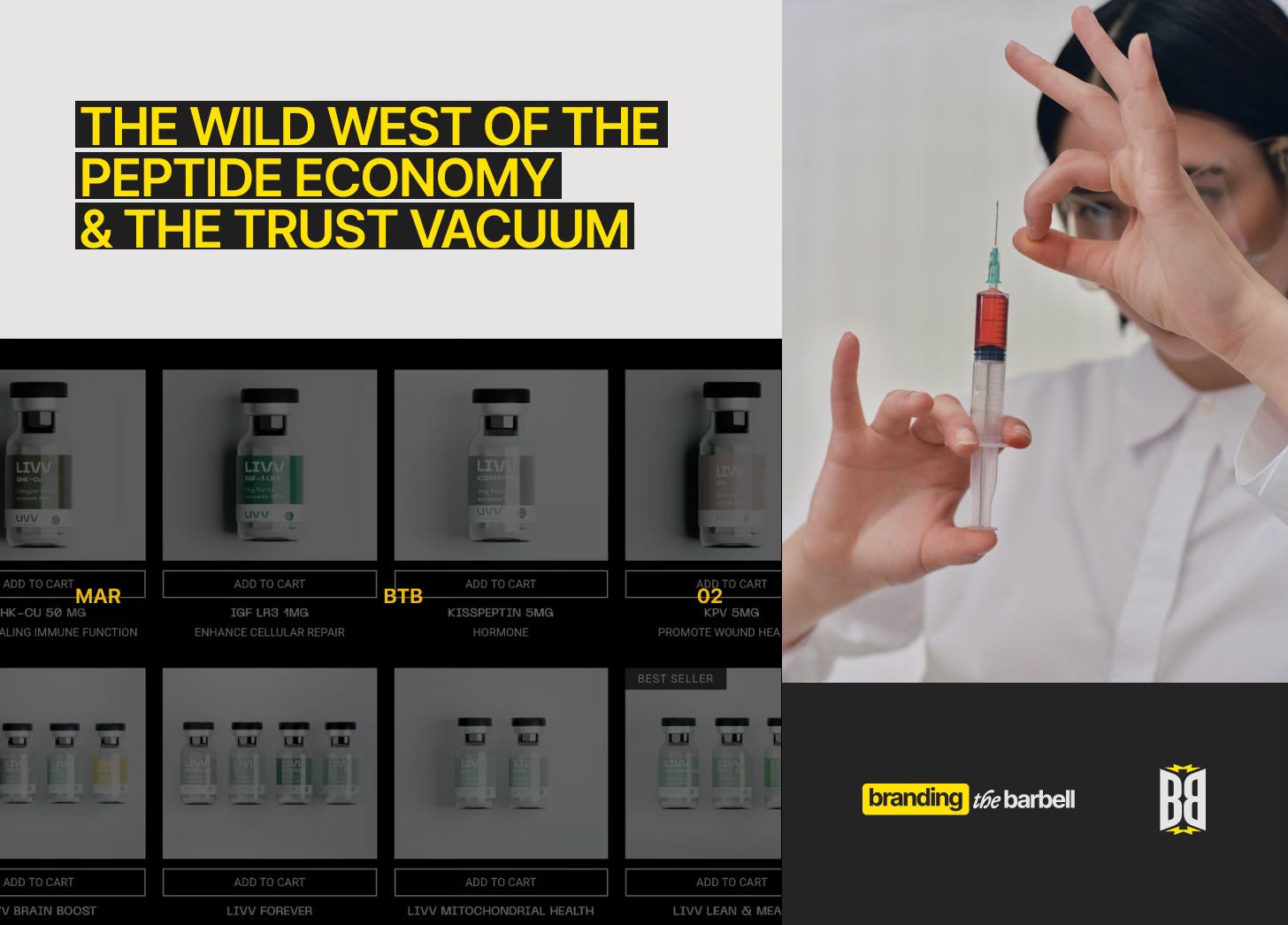
Welcome to Branding the Barbell. This week, we’re deep-diving on the economy that’s growing in popularity but not necessarily in regulations. And that, my friends, is the peptide economy. I’m also sharing some of the things I’ve had my eye on this space from Xenom to Nike ACG’s ice race.
It’s a weird, wild world out here in fitness and wellness—but I wouldn’t want to be anywhere else (most of the time.)
Let’s dive in.
The next frontier.
A category that most consumers couldn’t define two years ago is now being positioned as the next frontier of optimization as we see peptides enter the conversation beyond reddit and into longevity clinics and your favorite celebrity’s wellness stack.
Peptide searches surged 550% this year at The Vitamin Shoppe, while over 80% of longevity clinics now offer MD-supervised peptide protocols. Life Time opened longevity clinics in its gyms, and women’s health platforms like Wisp are partnering with peptide labs to develop targeted therapies.
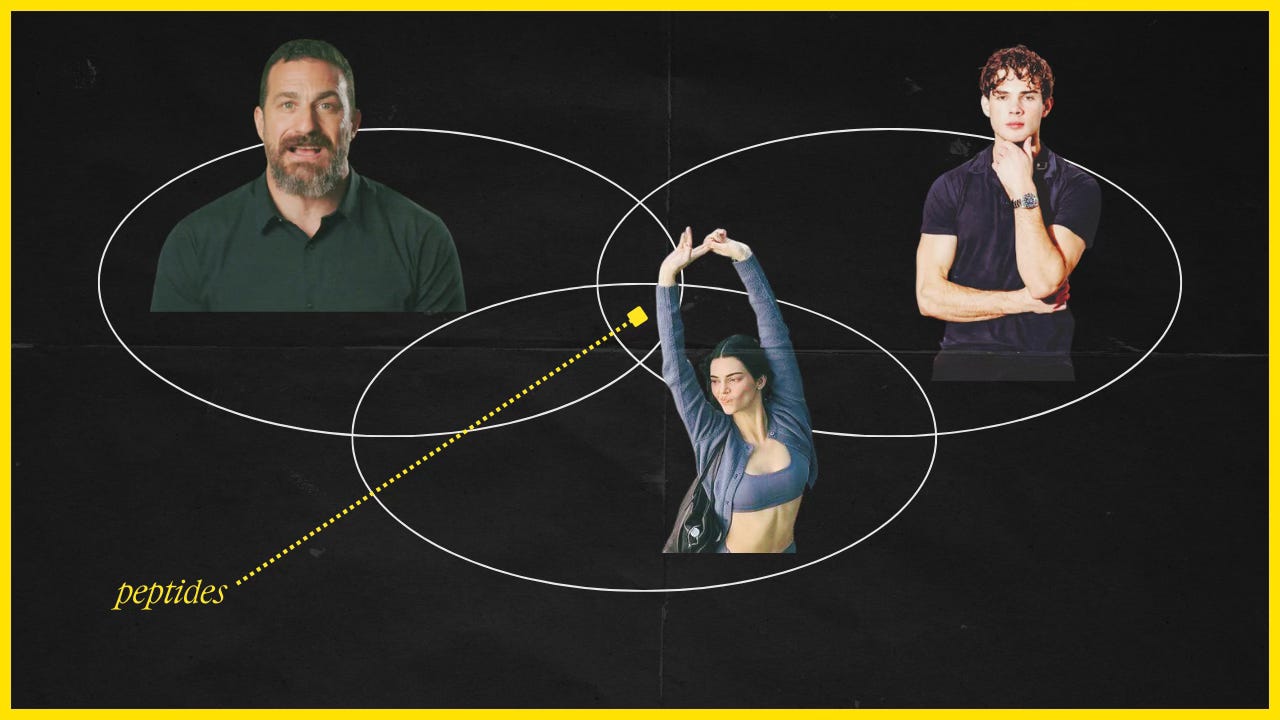
And as the elite are popping glp’s and the bros are bone-smashing, we’ve entered an interesting convergence of worlds. Traditional self-optimization culture that we’ve come to know as eating well and prioritizing your mental health is now overlapping with the opposing force that is conventional beauty standards rising to increasingly impossible heights. But instead of the deprivation culture we saw reign in the early aughts, it’s optimization.
Quick-fix culture, existenialized.
Many consumers are growing exhausted by over-optimization and are leaning into counter-trends. For some, that’s ditching the wearable and leaning on intuition as their guide to wellness. For others, their adopting habits that are almost so contrary to wellness itself it seems unwell (see the million think pieces written about Thom Garland’s poignant observation in “The Rise of the Wellness Anarchist.”)
While the hyper-optimization culture of peptides at first glance may feel contrary to the exhaustion, it’s actually its final form. While we grow weary of tracking all the data and implementing all the habits based on said data into our already overextended lives, peptides serve as an escape hatch. We can ditch the tedious work and dive into a world where our bodies crave less of what we don’t want and manufacture more of what we do want.
Do your own research, unless, of course, you’re the FDA.
Now to truly understand the culture the peptide economy exists within, you have to start with the pandemic. In this era, while younger generations began prioritizing a larger chunk of their disposable income and hours toward wellness, we witnessed increasing skepticism toward pharmaceutical companies, regulatory bodies, and traditional healthcare systems. In its place, a culture of “doing your own research” and “taking back your health into your own hands” rocketed to the mainstream.
In the US, while the FDA has attempted to restrict certain peptide compounds, political oversight has pushed back and it looks like regulatory oversight may actually decrease—at least in the near term—rather than increase. This creates an unusual market environment as early movers can establish category positions before rules crystallize. We’ve seen a surge of brands begin implementing peptides from low-dose consumer products to high-margin clinical services.
The traditional system of trust in this sector has shifted.
While the democratization of wellness information rose, celebrity and influencer adoption of peptides has created powerful social proof. Joe Rogan discusses peptide use for tendonitis recovery while reality tv stars chat while getting NAD+ treatments, unintentionally positioning peptides in the market as the tool of high-performers and status holders.
Where we’ve seen evidence is limited, personal testimony fills the vacuum. This creates an interesting dynamic where anecdotal evidence often becomes more culturally powerful than the absence of traditional clinical evidence.
Now this is an important dynamic for brands to understand, as this new system of trust suggests that building trust infrastructure may be just as valuable as building evidence bases, at least in the near term.
There are three potential trajectories that I suspect we’ll see the peptide economy follow:
(Not necessarily mutually exclusive.)
Legitimization through verticalization. Large wellness brands and healthcare systems are integrating peptide protocols into comprehensive longevity offerings, like Life Time's MIORA clinics, that test whether peptides can anchor premium healthspan services. If this model works, peptides become standard components of high-end wellness, normalized through institutional adoption.
CPG normalization. Brands are already incorporating low-dose peptides into skincare and wellness products and companies like The Ordinary and Typology are already using peptides in personal care, following the collagen peptide trajectory. Ubiquity at doses that may have minimal effect, but creating massive category awareness and consumer comfort.
Regulatory or market correction. There’s still a slew of medical experts that aren’t yet fully endorsing all peptide protocols. Depending on the potential side affects downstream, research uncovering limited efficacy, or honestly increased regulatory restrictions, the future market may face an adjustment. The question for brands is becoming - how to build for growth while being dynamic enough to make corrections as needed.
Ultimately, what the peptide boom tells us about the modern wellness consumer is that they value autonomy. Whether you do business in this sector or not, understanding this consumer sentiment will be critical as brands approach marketing wellness in 2026 and beyond. The democratization of wellness is hitting its stride, and the brands that will in the new system of trust will priotize transparency and hand their consumers the tools to do take their wellness into their own hands.
Where do you think we’ll see things move?
In my algo:
Vintage activewear is absolutely BUZZING rn (putting a ✅ next to my December trend prediction there.)
CrossFit made a post marketing to Hyrox’ees for the Open (the comments say CrossFitters still have beef with this because if they’re not beefing they’ll lose their gains—little known fact.)
XENOM is here and it’s $500 a ticket
Art Basel but for Wellness is coming to Miami, and my studio branded it 🤪. Come hang with me here.
“It’s actually its final form” OOOOOOOOOOOOF!!! I was at a super normal globo gym last week and there were QR codes errrrrrrywhere for peptides out of nowhere. I saw Ben Pakulski say it’s the the 1998 supplement industry but in 2026.