


This week we have an exclusive behind-the-scenes look at TYR Sport’s CXT-3 campaign (that you’ve likely seen rolling out this month on socials.) I was able to hang out on set in Austin, Texas with TYR’s Director, Corey Berger, to talk about where fitness culture is headed in 2026 and how TYR is positioning its marketing to meet the moment.
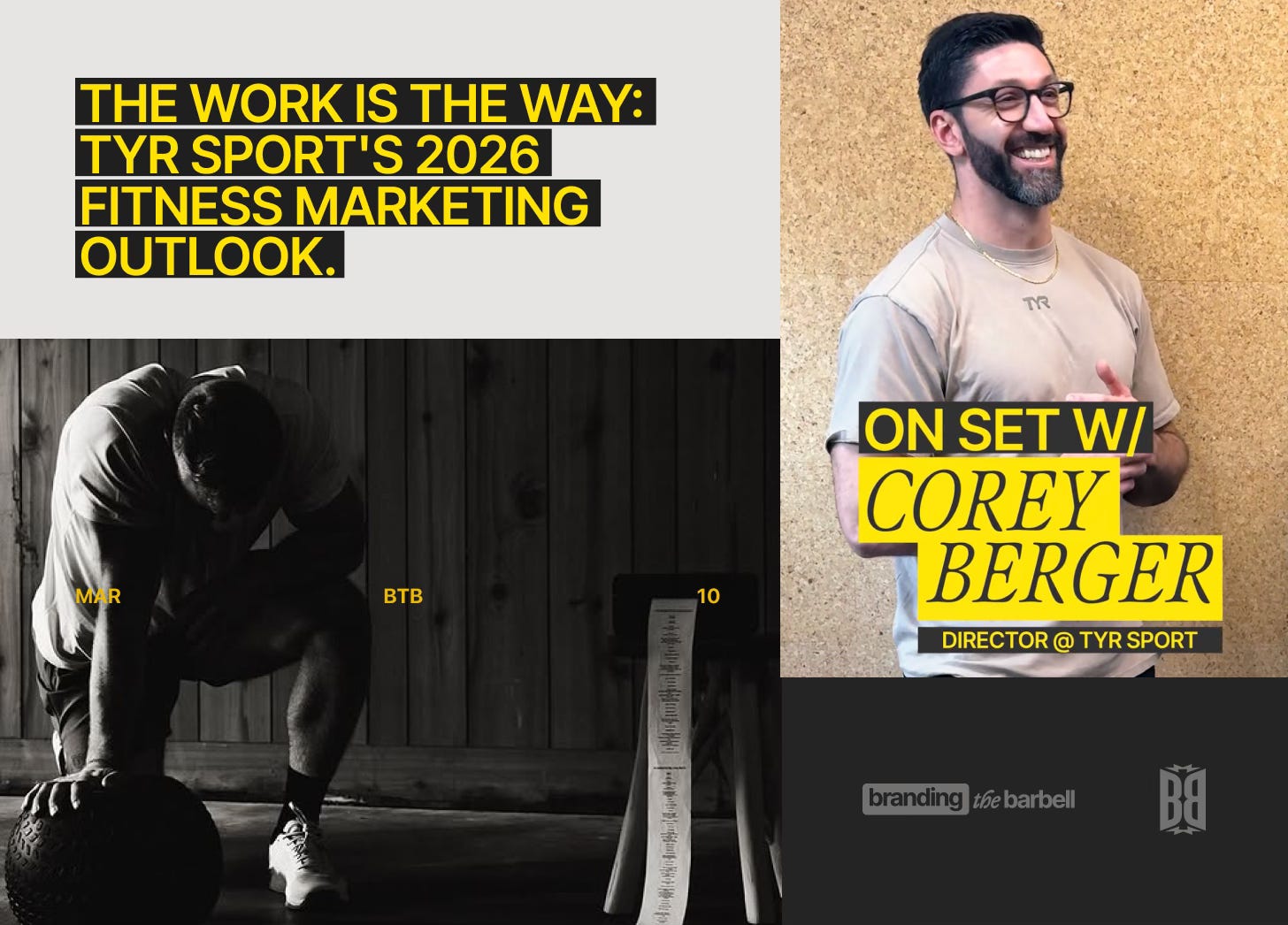
First, some background on TYR Sport’s entrance into the functional fitness arena.
When CEO Matt DiLorenzo started CrossFit in 2020, it sparked a new chapter for TYR Sport. One that would quickly reshape the brand’s presence in the fitness space. By Spring 2021, DiLorenzo had brought on Corey Berger, a two-time CrossFit Games team athlete and Level 1 coach, to lead the charge as Director of Business Development.
Since then, Berger has guided TYR’s entrance into the CrossFit world signing an impressive roster of Games athletes, partnering with major competitions like Wodapalooza and the Rogue Invitational, and showing up at grassroots events and local fundraisers alike.
“We have very specific values we believe in as a company,” Berger said in an interview with Morning Chalk Up early in his roll with TYR, “Being technically proficient and making sure our products work for everyone that puts them on. And number two, we’re focused on people who are driven to elevate themselves in whatever sport they compete in.”
Now, onto my convo with Corey…
Watch the full interview with Corey here or read on below!
Tatum: What's your read on the fitness landscape heading into 2026?
Corey: I think [the fitness landscape] is going to click back towards ambition. Not over-indulging in the wellness, but people are going to start to chase more. That's going to raise the level of fitness and the amount of intensity and effort that people put into it. We're going to trend back towards a little bit more of that hustle culture—go after it and get it. Go ahead and get your cold plunge, but focus on the work that's going to get you to your goal.
Tatum: So, the death of wellness—you heard it here first from TYR Sport's Corey Berger.
Corey: I mean, listen, you still have to do some of that. If you’re pushing really hard, chasing some ambitious goal for yourself—and when I say for yourself, I mean for yourself, not whatever anybody else thinks or whatever is happening online—you do still have to be cognizant of taking care of yourself so you can continue to stair-step towards what you’re trying to achieve.
We work with a lot of professional athletes who are pushing hard every day to insane levels, beyond what most people can comprehend. The rest of us scale it back from that, but relative to our own capacity, we’re pushing at a similar level. We’re feeling that same sore, that same tired. To an extent, the wellness stuff is going to help you continue to do that—but you’re doing it with intention. You’re not doing it just because it’s the cool thing or the popular thing. You’re not over-indulging in the recovery and the relaxing, because that’s ultimately going to keep you from making that next step towards your goal.
It’s about being more methodical—using recovery and wellness as a tool on your road to that goal. You’ll still see the running, you’ll still see the hybrid thing, but we’re going to start to see more heavy weights, more technical movements. People are going to look for that next level. That’s where I think we’ll see a lot of interesting things happen this year.
Tatum: Do you think we'll see a shift from trend-hopping to people committing to the sport they actually love?
Corey: I think it'll be a bit of both. For me personally, I like to dabble in a little bit of anything. If a buddy calls and wants to go do an ultramarathon, I'm in. Or I'll go hit some heavy power cleans with these guys—that's fun. But yeah, people are going to get more specific with their training. I don't think it'll kill the hybrid movement. What's going to happen is people are just going to look for the next level.
At a certain point, as human beings, we're innately ambitious. It's just how we've developed everything—we're in Austin seeing self-driving cars, right? It's a natural part of life to want to evolve and progress. We've seen people sit in a comfort zone recently, which was nice, a bit of a reset. Now I think we're going to see people say, "Okay, I've got this foundation, this baseline—what can I achieve? What's that next level?" They're going to get there and want to know: "I've proven to myself I can do this. What's next?" Maybe it's an ultramarathon. Maybe it's trying to compete at the CrossFit Games. But people are going to be more open about their goals and more intentional and ambitious about achieving them.
Tatum: And that all comes down to process and training—“the work is the way,” yeah?
Corey: The work is the way. Exactly. That’s why it connects really well to what we’re planning from a marketing perspective. We want to be that support for people. We want to highlight that story and say: it is important to be ambitious. It is important to stake your claim. Put it out there. Don’t be so worried—tell people what you’re going to achieve, and then go achieve it.
For us as a brand, our goal is to be there to support you in whatever you’re trying to achieve. All the product we develop, the athletes we work with—it’s about showing people what’s possible. It’s almost like Alfred to Bruce Wayne: we’ll make the cool tech for you to go do your thing.
From our marketing perspective, the question is: how can we help people connect to that story? If we only ever show these incredible athletes at the Olympics or at the Games, there’s a disconnect. It’s cool, it’s aspirational, but the majority of people aren’t chasing that exact goal. Their goal is different.
The campaign we’re working on right now is really just about this: the work is the way. Everybody’s doing some version of work towards whatever version of their goal they have. If we position our marketing to say, “We’ve got the tools for you, we get what you’re after, we’re there with you—we’re you in a sense”—that’s going to create a much stronger connection.
For us as a brand, that’s the focus. Not following the hype or the noise. Just being direct: we get it, you want to achieve something—we got you.
Thank you to TYR Sport for giving Branding the Barbell readers an exclusive behind-the-scenes look at the CXT-3 campaign. If you’d like to check out the creative studio behind the campaign, check out Alex Garcia’s House of Distribution.
In the meantime, follow Corey’s work at TYR @corey.berger_ and @tyrsport on Instagram.