


Every January, the fitness industry holds up a mirror. Historically, that mirror reflects back the same tried and true, relatively boring and predictable messaging we’ve grown to expect from fitness — with the occasional sensual and sensationalized outlier moment from Equinox.
But this year, as fitness and wellness is steadily eating up space in culture, the campaigns that these brands chose to run reveal what they believe about their customers, their category, and the culture at large. The campaigns that cut through did so by rejecting the predictable optimism that has defined “resolution-season” marketing for decades.
And after analyzing what I think are some of the most notable campaigns of the month I’ve synthesized what they reveal to us about not only the industry and consumer psychology, but where fitness culture is heading.
Strap in.
January 1 actually isn’t January 1
One of the more significant strategic shifts this January was about campaigns timing. And this is something I think we’ll see bleed into many industries — the irrelevance of time. My favorite brand strategist Jasmine Bina wrote that we are now marketing in The Eternal Now. As trend cycles move at the speed of light and our collective cultural consciousness forgets a moment as quickly as it happens, days like January 1 can lose some significance in the world of advertising. And as fitness actively seeks to meet consumers where they are, multiple brands hit the new year with new frames on resolution timing.
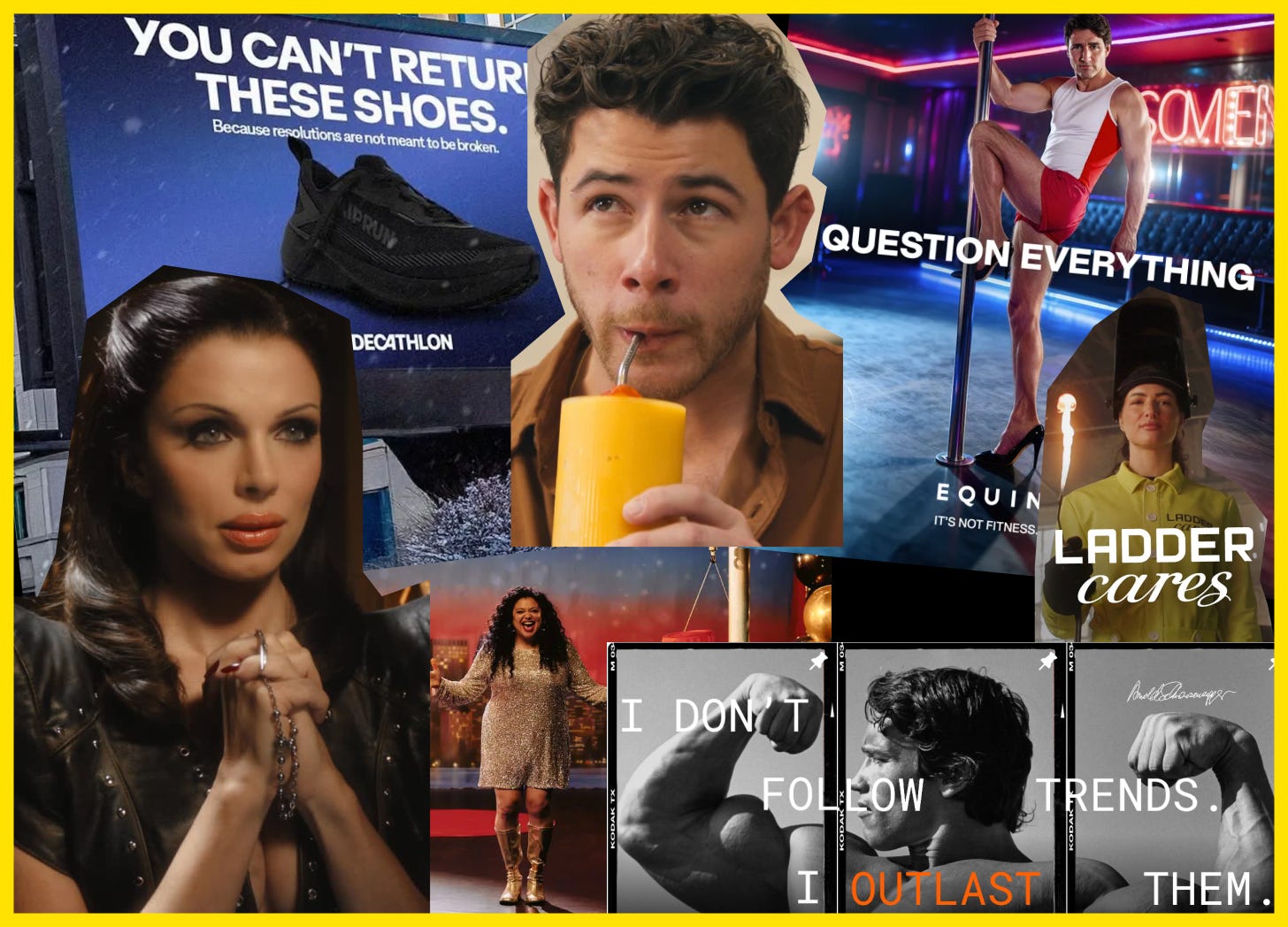
Ladder zeroed in on January 9th, the second Friday of the month colloquially known as "Quitter's Day," named for the idea that this is when the majority of folks abandon their resolutions. Their Instagram spot showed fitness equipment being repurposed with the tagline: "This Quitter's Day, we're turning abandoned fitness equipment into… actual fitness equipment." What they’re accomplishing with this campaign is positioning their brand alongside the very data-backed human inevitability of failure and reframe it from being a crisis of character to be avoided but an opportunity for further connection. By acknowledging that quitting happens and hey, we’re all human here, Ladder positions itself in users lives as an ally rather than a judge. A great recipe for a high LTV, if you ask me.

Decathlon took a less approachable angle. Working with agency Rethink, the retailer made their best-selling KIPRUN 500 WR running shoes intentionally unreturnable throughout January. Customers who purchase must acknowledge at checkout that they’re waiving return rights as a symbolic commitment. Now this has heavy echoes of the classic Equinox strategy of “no signups on Jan 1,” but hey, it’s interesting to see this applied in retail.
“We’re using friction as a strategic tool for motivation,” explained Xavier Blais, partner and executive creative director at Rethink. “It transforms the brand from a vendor into an accountability partner.”
The campaign sweetens the commitment with 1,000 loyalty points for customers who keep their purchase for 30 days. With that data that 92% of resolutions fail in hand, Decathlon bet that upping the stakes could change behavior.
Premier Protein actually had my favorite application of this theme with their campaign. Working with Ogilvy and comedian Michelle Buteau, Premier formally declared that New Year’s doesn’t start on January 1st, it starts on January 5th, when the holiday haze lifts and routines actually resume. This is a legacy brand coming to us with a simple, relatable idea, and that’s why I think it works.
These campaigns are all timed to moments of potential failure — that’s the magic. The fitness and wellness industry is widely leaning into what behavioral science has known for years: shame doesn’t create lasting change, and meeting people at their point of struggle rather than their point of aspiration can build deeper brand relationships.
The Authenticity Crisis Has Reached Fitness
Something broke in 2025. The proliferation of AI-generated imagery, deepfakes, and synthetic content created a cultural hunger for anything provably real. Fitness, with its sweat and physical undeniability, became an unlikely answer.
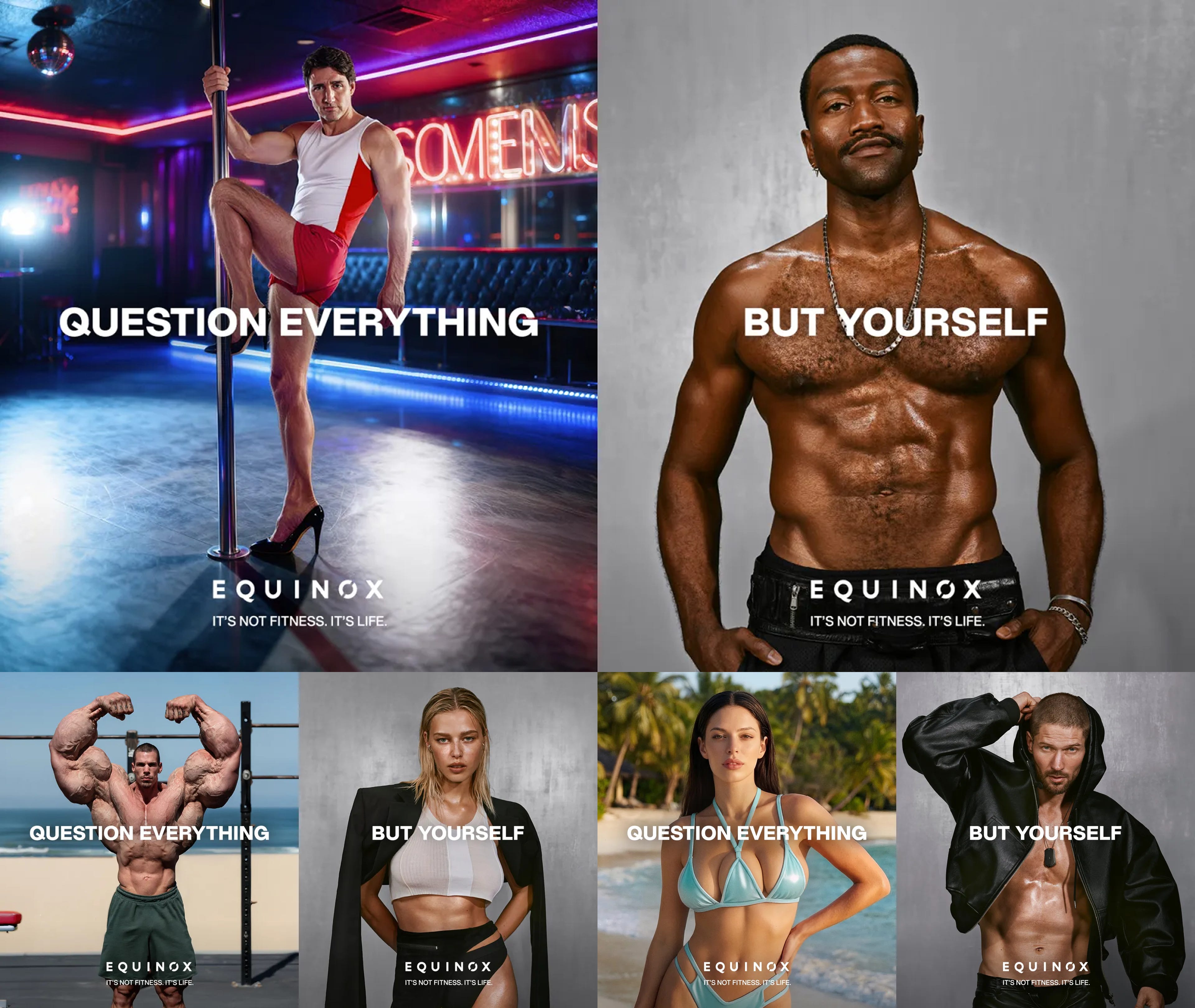
Equinox understood this most with their “Question Everything But Yourself” campaign. Here they deliberately juxtaposed “AI slop” like the pope in a puffer jacket or pole-dancing Justin Trudeau against stark, sweat-drenched portraits of real athletes. As much as I feel that many of the brand’s campaigns are just Equinox trying to “out-Equinox” itself, this one hit for me. It’s grabby and controversial like Equinox loves to be, while sending the message that when everything digital can be fabricated, the body becomes the last honest medium. Here we’re seeing the brand position itself beyond the overdone and exhausting “place for self-improvement” into a sanctuary for reality. Physical effort becomes a form of protest against digital fabrication.
The strategic choice to launch this as CMO Bindu Shah's first major campaign after joining from Tory Burch signals that Equinox sees its competition less as other gyms and more as the attention economy itself. Brands, take notes.
Almond Breeze brought us a more approachable application of the anti-AI sentiment through their “The Pitch” campaign featuring none other than the Jonas Brothers (millennial women, hold your applause.) The short film directly parodied AI-generated advertising we’re becoming increasingly exhausted by taking Nick, Joe, and Kevin through increasingly unhinged concept pitches from "brand partnership agents" who use AI to create campaigns. Eventually, the brothers settle on a simple, direct message: the almond milk is "Really Good." That's it.
The reason I love this campaign is because it shows us that restraint can outperform hype and absurdity when trust and brand affinity are on the line — which brings me to my next category…
The Anti-Trend is The New Trend
The last era of fitness and wellness could be reduced to the title: “hype-driven wellness optimism.” Running gear positioned as streetwear, hybrid athlete influencers making fitness “cool” again, viral Strava fit checks, brand races, brand activations, brand everything. As the saturation of trend and optimisation has reached critical mass, we’re seeing wellness overwhelm seep in everywhere. Consumers are tired and the once-optimistic culture around fitness and wellness has become meme-ified.
Enter the authority over novelty chapter.
Momentous launched their partnership with none other than Arnold Schwarzenegger with the campaign “Trend Proof.” This campaign promotes The Arnold Stack: protein powder, creatine, vitamin D3 — three foundational supplements with decades of research. Schwarzenegger stated it plainly: "I've seen every fitness trend come and go. Trends don't build greatness. What actually works has never changed: committing to the basics and doing them well and consistently."
When consumer trust is fragile and the market is saturated with innovation claims, "we've done this for decades" becomes its own competitive advantage. Well done, Momentous.
Timeline, the Swiss longevity company behind Mitopure, launched its first U.S. national campaign with a deliberate linguistic flip. The cinematic spot, directed by Ja'Lisa Arnold of Love Song, follows a woman navigating the "uncanny dissonance of midlife" before discovering cellular health science. The key strategic choice: Timeline explicitly rejected "anti-aging" language in favor of "pro-longevity." As the longevity industry has historically positioned itself as both at war with aging and sensationalist through fringe, hyped, “quick fix” expensive tools — the CMO Federico Luna stated “…it's about giving people the real tools to live better for longer."
BPN ran multiple January micro-campaigns including “The Year to Commit,” “Only the Work,” and “Be the 12%,” with a particular focus on process, unsexy hard work, and strength training. Their approach, to me, demonstrated how a challenger brand can maintain presence through consistent smaller activations rather than a single tent-pole campaign.
This brand in particular is one to watch as they’ve been a heavy target for meme pages. When a brand does such a good job at popularizing a trend — in this case, hybrid fitness — it’s adopts the identity of the masses that jump on the trend that can anchor it as “over.” This is a unique challenge that more brands are facing in the era of social media and lightning fast trend cycles. We’ve seen it happen to Bandit Running and Satisfy as well. And if you want a prime example of how to pull your brand out of the memes and set the new standard, I think you should be watching BPN this year.
Wellness Is Actually About Feeling, Not Function
One of the most interesting things I’ve noticed this January is seeing brands lean heavily into the feeling of participating in wellness more than the result of it. We could attribute this to the rise of optimization-fatigue, but I think even that fatigue stems from our lack of anchor to time. How can we be motivated to optimize ourselves when we can’t even imagine the future? The answer, turns out, is the feeling of the task itself. To quote Jasmine Bina yet again,
“Lifestyle and aspirational branding doesn’t land when people can’t see into tomorrow and have lost their desire to plan for who they may become. Heritage branding doesn’t land when our history is slipping through our fingers and begins to feel alien.”
And here we sit.
Crunch Fitness built their entire January campaign around this insight with their campaign “Feel More.” They brought in Hype Williams, the director behind iconic music videos for Beyoncé, Missy Elliott, and Busta Rhymes, to shoot the campaign set to Montell Jordan's "This Is How We Do It." Big-box gyms can feel isolating, and we’re seeing the big players come out with campaigns that lean into the social and feeling aspect of fitness beyond the actual “results” of working out itself, which I find particularly fascinating. The campaign also showcases Crunch's new 3.0 gym concept, featuring upgraded design and “Relax & Recover” services — something I predicted would happen in this video.
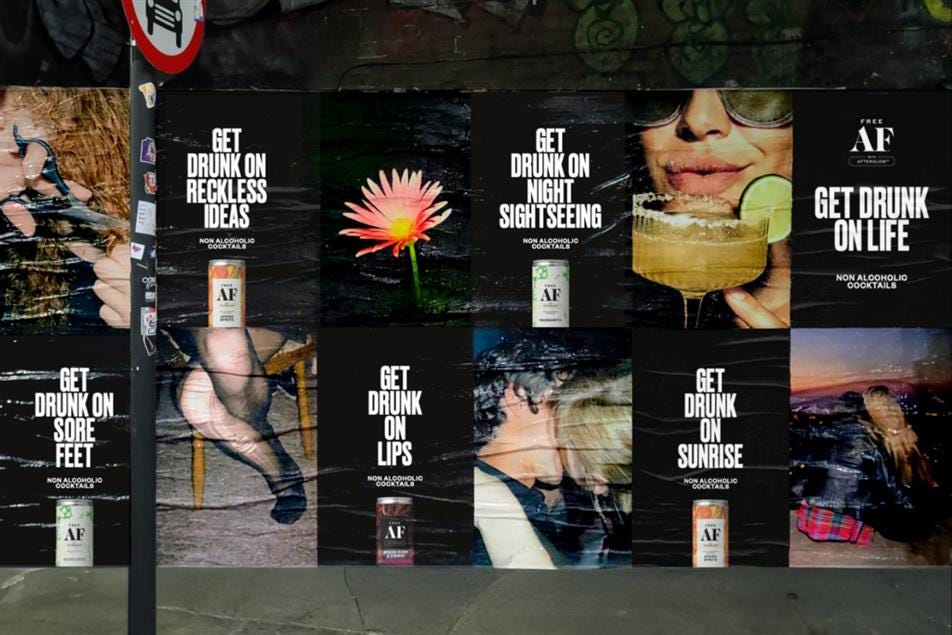
Free A.F., the U.K. nonalcoholic cocktail brand, flipped the traditional script of “Dry January” and isolating abstinence with messages like "Get drunk on reckless ideas" and "Get drunk on sunrise” on guerrilla fly posters across London. The goal here is to reframe sobriety by associating it with expressiveness and cultural participation, anchoring sobriety as in fact, fully experiencing the present moment. We all actually want to party, after all, as Thom Garland says in his piece for Edition Partners on “Wellness Anarchy.” I honestly love the idea of reclaiming the word “drunk” as a NA brand.
Remember Zumba? This might be the brand that grew by marketing the feeling of fitness in the 2000’s while other brands were posting before and after photos. This January, Zumba built their global campaign around the simple premise: it’s actually a ton of fun to move to great music. This spot shows people dropping everything when "Gasolina" by Daddy Yankee plays, rushing to attend class.
Wellness Is, In Fact, Absurd
And finally, the campaigns that generated organic sharing and conversation led with entertainment and absurdity. As fitness and wellness brands grab the investor dollars, we’re seeing more and more highly produced and art directed campaigns. And as the distinction between "content" and "advertising" has collapsed, brands recognize that they are now competing for attention against everything else in the feed.
Perfect Bar created a Broadway-style musical number starring Harvey Guillén (of What We Do in the Shadows) singing an anthem for shorter shoppers who can't reach the brand's products on high refrigerated shelves. The campaign is unapologetically absurd as Guillén performs musical-theater-ready choreography among towering grocery store shelves. I’m obsessed with the idea of turning a genuine retail placement challenge into entertainment.
David Protein leaned into absurdity through provocation with their "Devour" campaign starring Julia Fox. The campaign features Fox in a confessional booth delivering sexual euphemisms about giving in to temptation. The tagline on OOH billboards: "Men disappoint. David satisfies." This campaign generated more debate than perhaps any other fitness-adjacent campaign this month, which I would argue, was the goal. David’s earlier campaigns were so centered in tech-bro minimalism and macro optimization that the pivot to the female gaze makes sense. Some critics call it an "identity crisis," I call it, “getting eyeballs” — which, it got. Personally, I love Julia Fox and I think this campaign is so fun and camp. Whether it wins the female target demo or not, we shall see.
What January 2026 Tells Us About the State of Fitness
We are officially exiting the era of wellness optimism. The industry is consolidating, saturating, and consumers are smarter. There’s something innately absurd about optimizing our bodies while the world burns, yet we long for a future that looks different than our present moment. As brands and consumers sit at this intersection, the conversation has to become either ultra-human, about this present moment, or an absurd escape hatch from reality.
What I tell the brands I work with at my studio is that dichotomy and tension creates brands that resonate in an increasingly saturated marketplace. We as humans carry conflicting personality traits and we resonate with brands that do the same. One-note brand strategy, messaging, and campaigns no longer work as we try to navigate the world while holding two things in one hand: optimization and presence.
You must be interesting.
You must hold tension.
And, most importantly, you must call your senators.
Happy January fit friends,
Tatum Brandt